


Rather than boring shoppers with a long list of product specifications, Sleep Savvy believes in the importance of retail sales associates emphasizing the benefits of mattress components.
To be able to talk about those benefits, RSAs should be well educated on the particulars of components—their materials, constructions, and uses. Such knowledge allows RSAs to answer any questions detail-oriented shoppers might ask and conveys a level of expertise most consumers value.
“To me, coil conversations with customers have always been very fluid, based on a customer’s knowledge, needs, and curiosities,” says Chad Antinori, president of Future Coil based in Tampa, Florida. “A customer who wants to know more about the coil support system may be more open to tech specs and design features, where a more timid customer would prefer a KISS (keep it simple, stupid) approach, with the focus simply on the benefits and feel.”
We’re delving into coils and spring units so you can meet the needs of both types of shoppers.
The benefits
Steel coils have several benefits in mattress construction. They provide sturdy, long-lasting support for sleepers, and they foster airflow throughout the mattress for a cooler night’s sleep. Bonus: At the end of a bed’s useful life, the springs are recyclable, making them sustainable—a possible selling point for environmentally conscious consumers.
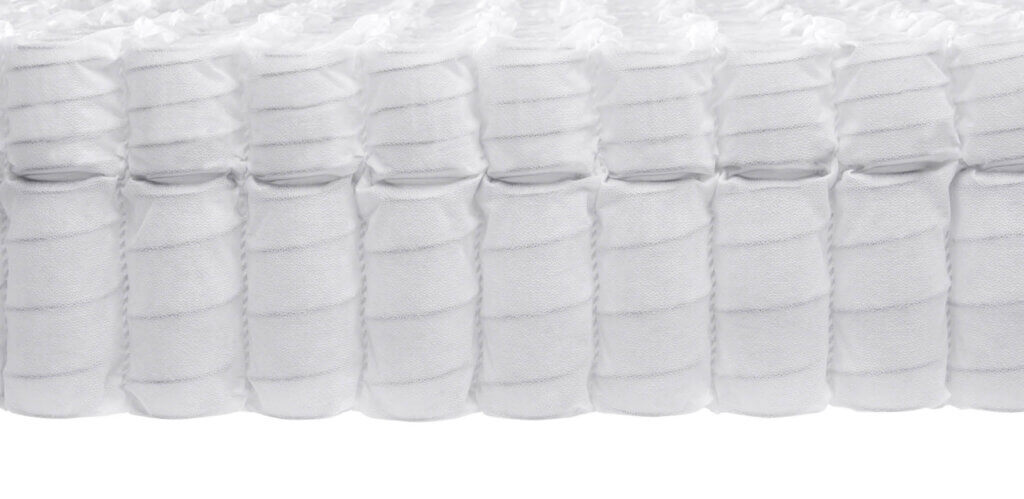
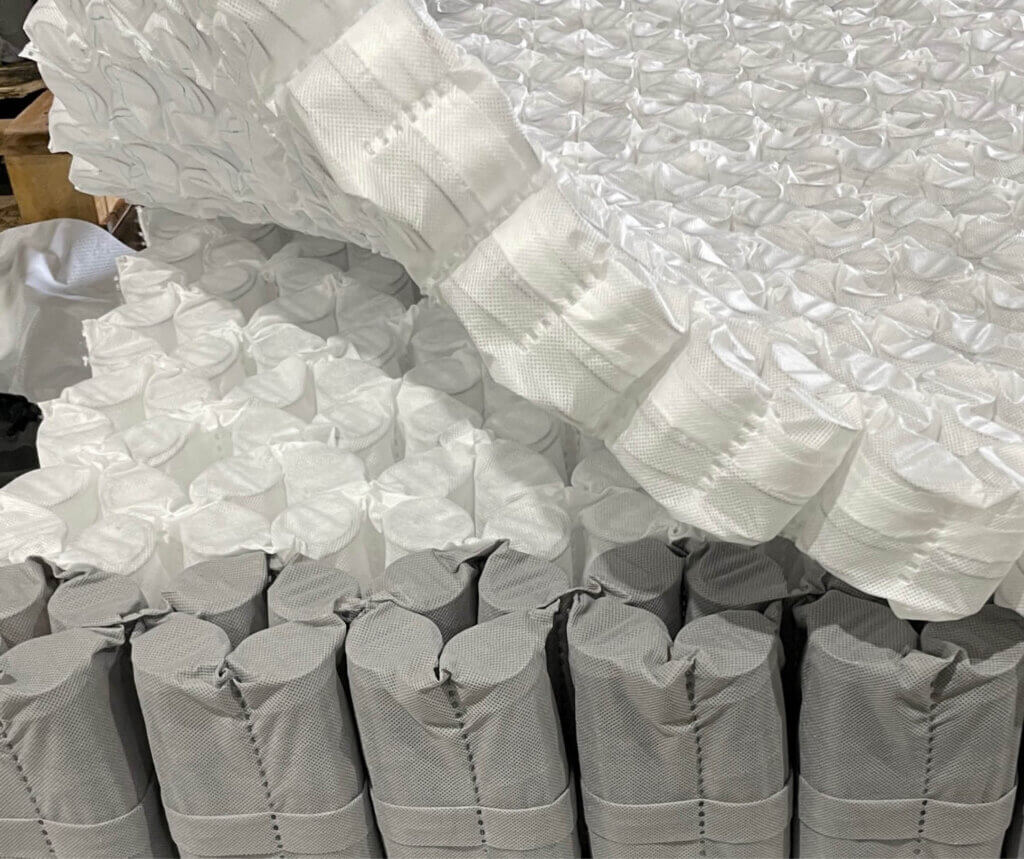
Once primarily used as the core of innerspring mattresses, coils can now be found throughout the mattress, providing both support and comfort from the center to the edges to the topmost layers. Zoned innerspring units provide support for different parts of the body. Pocketed coils—fabric-encased springs that have become the dominant coil type in today’s innerspring and hybrid mattresses—help prevent motion transfer between sleepers.
“Over the past decade, the industry has moved away from the ‘all-foam’ craze as sleepers started realizing they wanted cooler nights and better support,” says Matan Wolfson, director of business development for Texas Pocket Springs. “That shift brought pocket coils back into focus. … What’s exciting is that modern pocket coils are far more advanced than the ones we saw even 20 years ago.”
Darren Marcangelo, chief commercial officer for Spinks, the springs division of Leeds, England-based Harrison Spinks, agrees—and notes that today’s coils are no longer just about support. “Modern spring technologies offer comfort, pressure relief, airflow, and durability all in one,” he says. “RSAs still sometimes encounter shoppers who picture old Bonnell or continuous coils. Part of the job today is resetting that perception.”
Innovations
For an idea of how springs are advancing—and what that means for your customers—the suppliers Sleep Savvy talked with shared some of their newest and most successful products.
Brian Akchin, vice president of sales for A&S Innersprings USA, based in Windsor, Connecticut, points to the company’s Dual Active Coil System. The design features two coils of the same diameter but with different wire gauges in the same pocket, creating a plush initial feel with firm support beneath. The result, he says, is improved comfort with fewer layers above the spring—good for sleepers and for bedding producers managing costs.
Texas Pocket Springs offers a comfort coil called the QuadMini, a 3-inch version of its QuadCoil designed to mimic a medium-firm latex feel. “It’s a proper coil—a 6-inch coil in a 3-inch pocket,” Wolfson says. Used with minimal foam or latex, the QuadMini helps disguise coil feel while improving breathability.
At Future Coil, Antinori points to the company’s exclusive V-Coil technology, which positions pockets at a slight angle so rows of coils form opposing V-shapes. “Each V becomes a complete triangle, creating a truss system throughout the unit,” he explains. The design improves load distribution, reduces material use and increases flexibility—especially on adjustable bases.
Spinks has also focused heavily on expanding what coils can do in comfort layers. Marcangelo says the company has launched several innovations in microcoils and pocketed cores that will reach retailers in 2026. One example is Microlution, a two-stage microcoil that pairs a larger active coil with a smaller response coil to deliver plush initial comfort followed by conforming support. Another is Quadrolution, an evolution of Spinks’ QuadCore pocket system that allows additional coils to be added within the core.
“That lets us customize edge support, complex zoning and even phased zoning in ways that weren’t previously possible,” Marcangelo says. Spinks has also introduced Micro Copper, an antimicrobial, antifungal option available across many of its microcoil designs that can be positioned close to the sleep surface.
How coils are being used differently today
One of the biggest changes in mattress construction is the use of multiple coil layers—not just for support, but for comfort as well.
“In the past, brands might double-stack coils,” Marcangelo says. “Now, many manufacturers use multiple layers of coils because they function as comfort layers, not just the support structure.”
Microcoils have made that shift possible. Because they are highly resilient and always return to their original height, microcoils help mattresses maintain feel and performance over time—unlike some filling materials that compress, soften and lose loft.
How to talk springs with consumers
Springs suppliers consistently emphasize one message: Focus on benefits, not technical overload.
“Everything begins with the coils,” Wolfson says. “They should be the foundation of any mattress presentation. Today’s shoppers value transparency, and they want confidence they’re investing in real quality—not just a marketing narrative.”
Akchin agrees, noting that encased coils provide individualized support based on body type. But he cautions against getting bogged down in wire gauges or excessive technical detail. Coil geometry and design matter more than a single specification.
Marcangelo takes a similar view. “Shoppers don’t buy a mattress because of the coils inside,” he says. “They buy because it feels supportive, durable and comfortable.” While wire gauge can be too technical, he notes that coil count is a concept many consumers already understand—especially when RSAs can show them a microcoil and let them feel how soft and flexible it is.
The key, he says, is always to translate features into benefits:
- Pocketed core coils provide adaptive support, airflow, durability and reduced partner disturbance. Because each spring moves independently, the mattress supports the body where it’s needed and eases pressure where it’s not.
- Microcoils add responsive comfort. Acting like thousands of tiny shock absorbers, they provide gentle contouring and pressure relief without trapping heat. More layers mean more precision and more points of contact to fine-tune comfort and support.
Get shoppers comfortable with microcoils
Some shoppers may worry about feeling springs near the sleep surface. Akchin suggests focusing on airflow and cooling benefits. Antinori recommends encouraging customers to lie down in their preferred sleeping position to experience the comfort firsthand.
Marcangelo adds that modern microcoils are designed to eliminate those concerns entirely. Spinks uses extremely fine wire—its thinnest measuring just 0.67 mm—so the coils behave more like fiber than traditional steel wire. The coils are also designed with tucked-in ends to prevent them from working out of their fabric encasements.
“We invented microcoils more than 20 years ago,” Marcangelo says. “They’re now a prominent feature in mattresses around the world, and they play a major role in comfort—not discomfort.”
Words to Know (So You Sound Like the Pro You Are)
Bonnell: A knotted, round-top, hourglass-shaped steel wire coil. When laced together with crosswire helicals, these coils form the simplest innerspring unit, also referred to as a Bonnell. These are less commonly used in mattresses today.
Coils: The individual wire springs that form an innerspring unit.
Continuous coils: An innerspring configuration in which the rows of coils are formed from a single piece of wire.
Gauge: A measurement of the diameter of the
steel wire used in coil construction. Wire gauge
for core innerspring coils range from 12½ to 17; wire gauges for microcoils are usually thinner than for innersprings.
Helical: A tightly coiled, elongated wire used in the production of innerspring units to join individual coils to each other and to the border rod.
Hourglass coils: Coils that taper inward from top to middle and outward from middle to bottom, resembling an hourglass in shape. Employed in Bonnell and offset coil designs.
LFK: An unknotted offset coil with a cylindrical or columnar shape.
Marshall: A type of innerspring construction in which thin-gauge, barrel-shaped, knotless coils
are encased in fabric pockets, typically polypropylene fabric. Also known as pocketed springs or encased coils.
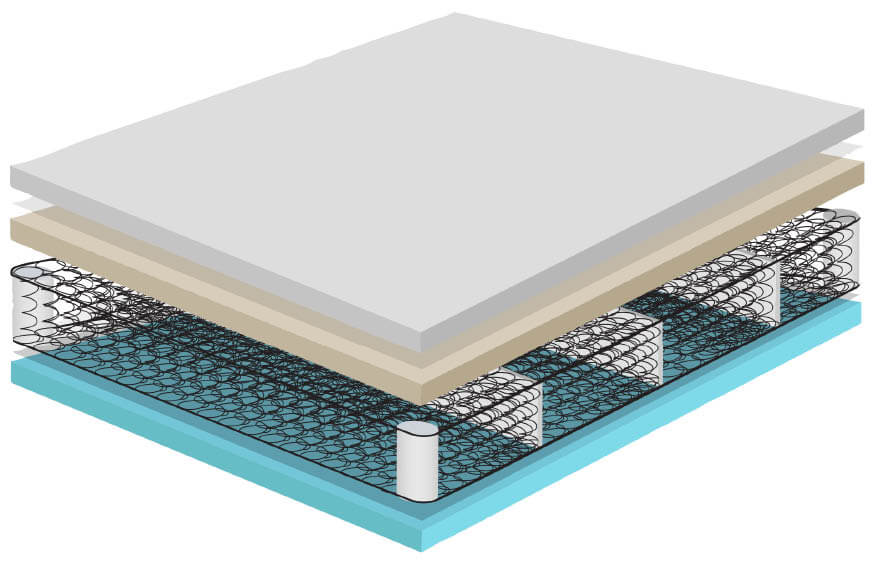
Microcoils: A low-profile spring unit, typically with pocketed coils less than 2 inches in height, used in the top comfort layers of a mattress.
Offset coils: An hourglass-type coil in which portions of the top and bottom convolutions have been flattened.
Spring wire: Wire made from high-carbon steel, characterized by toughness, strength, and ductility. It’s recyclable at the end of a mattress’ useful life.