
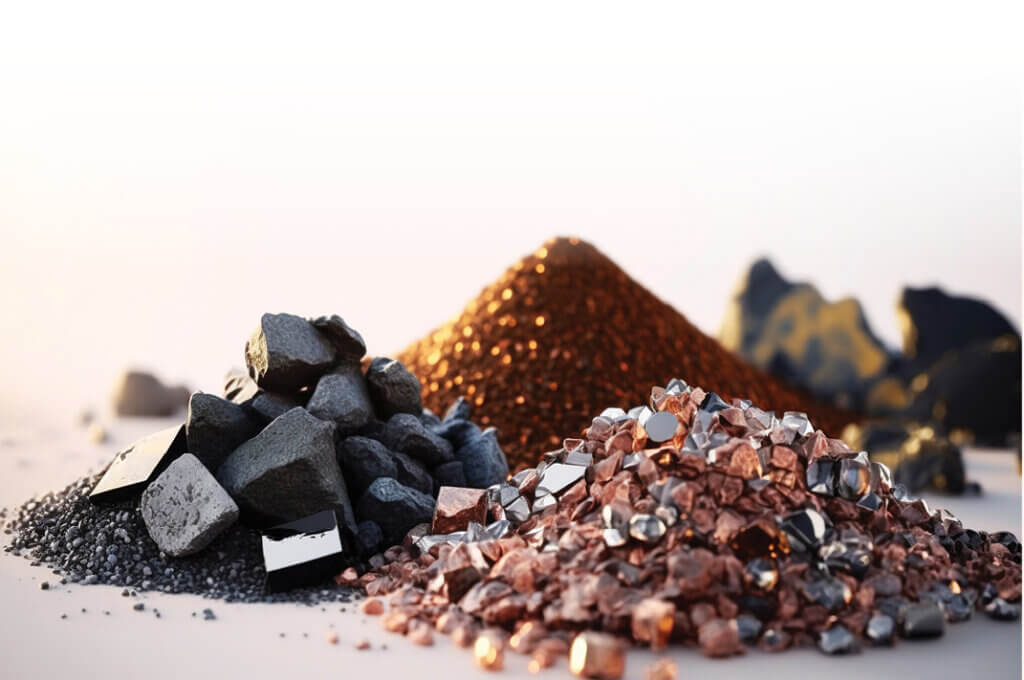
Today’s mattress shopper is encountering an expanding—and increasingly visible—ingredient list: copper, graphite, charcoal, silver, zinc, minerals, gel, and phase change materials. Some are positioned around a more temperature-comfortable sleep surface. Others support freshness, odor control, water-vapor management, pressure-relieving comfort, or broader wellness stories. This article focuses on performance additives, infusions, and cover technologies rather than a mattress’s core construction materials.
For retailers, these materials create both an opportunity and a challenge. The opportunity is a more compelling comfort story. The challenge is explaining what each material actually does without confusing the consumer, oversimplifying the science, or overselling the benefit.
No, retail sales associates do not need to memorize the periodic table. But they do need to know which benefit lane each material belongs in, what role it plays in the finished mattress, and what evidence supports the claims being made.
Copper, graphite, and charcoal may be among the best-known mattress infusions, but they are not the only materials appearing in today’s comfort, temperature, and freshness stories. Silver appears in some mattress covers and fabrics for antimicrobial product-protection or freshness positioning. Some proprietary gel-foam formulations are marketed under names that include terms such as “titanium gel,” although titanium itself is not a standardized mattress-material category. Zinc and zinc-based treatments are used in some antimicrobial textile applications. Mineral and ceramic blends, including infrared-responsive textile technologies, round out the broader wellness-materials category.

Different Ingredients, Different Benefits
Copper, graphite, charcoal, silver, proprietary gel-foam systems, zinc, mineral technologies, and phase change materials may all appear on today’s mattress ingredient list, but they do not perform the same function.
Some are intended to help manage heat; others are used in freshness, odor control, or antimicrobial product-protection applications. Some are incorporated into cover fabrics; others are used within foams or specialty comfort layers. Proprietary wellness technologies may be marketed around recovery, thermoregulation, or restful sleep.
The retailer’s role is to connect each feature to a clear, relevant shopper benefit. Because materials, formulations, constructions, and results vary, retailers should use only current, product-specific claims that the manufacturer has authorized for retailer use and can support with appropriate testing.
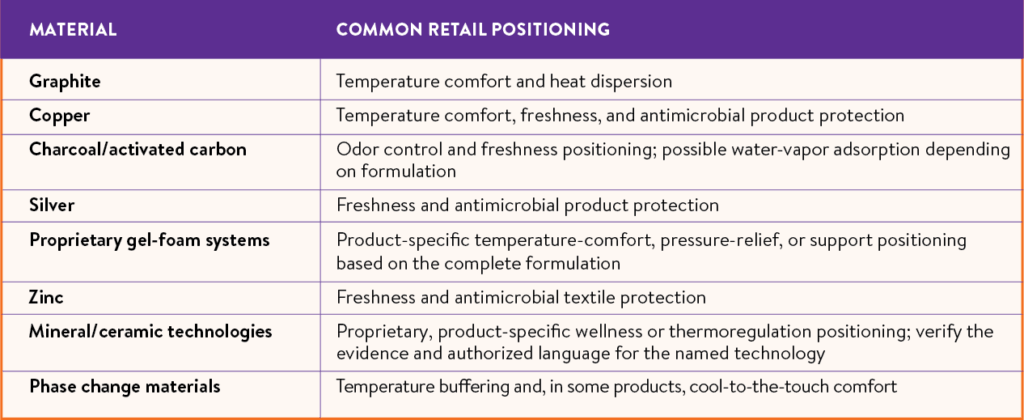
As a rule of thumb, graphite and copper most often appear in the temperature-comfort conversation. Charcoal belongs more naturally in the odor and freshness conversation, while silver, zinc, and some copper applications fit the antimicrobial product-protection story. Proprietary gel systems, phase change materials, and mineral-infused textiles may be positioned around temperature regulation, pressure relief, recovery, or comfort, depending on the particular product and the current, substantiated claims authorized for it.
Following is a closer look at some of the materials shoppers may encounter.
Graphite
Graphite is a naturally occurring crystalline form of carbon known for its ability to conduct heat. In mattresses, it is often added to memory foam as a powder, ribbon, or thin layer intended to help transfer heat from the immediate contact area and disperse it through surrounding materials.
Graphite is typically positioned close enough to the sleep surface to support a more temperature-comfortable feel, especially when paired with breathable foams, airflow-friendly construction, moisture-wicking fabrics, appropriate bedding, and a comfortably cool bedroom.
Some manufacturers publish product-specific surface-temperature results for graphite-enhanced designs. Any figures used in retail should identify the test method, duration, comparison product, and whether the raw material, a component, or the finished mattress was tested. A laboratory result from one construction should not be treated as a universal graphite benefit.
Beyond temperature comfort, a manufacturer may position a particular graphite-enhanced foam around breathability, moisture management, freshness, or other performance features. Those claims should remain product-specific and supported by appropriate testing.
Copper
Like graphite, copper is sometimes incorporated into mattress foams or fabrics as part of a temperature-comfort story. Copper itself is highly conductive, but the effect of copper in a mattress depends on its form, amount, dispersion, placement, surrounding materials, and the construction of the finished product.
Depending on the treatment and testing behind it, a copper-containing foam or fabric may also help inhibit the growth of certain bacteria or fungi on the treated material, including some microorganisms associated with odor. These benefits generally relate to freshness and protection of the treated material rather than creating a germ-free or allergen-free sleep surface.
Some manufacturers also position copper within broader wellness or recovery stories. Those claims should be treated separately from copper’s conductivity and antimicrobial product-protection properties and used only when supported by product-specific clinical evidence and specifically authorized for retailer use.
Cool to the touch is not the same as cool all night
“Cool-to-the-touch” describes the initial sensation when skin first contacts a surface. It does not, by itself, establish that a mattress will remain cooler throughout the night.
Charcoal and activated carbon
Activated carbon is a highly porous adsorbent with a large internal surface area that can attract and hold certain odor-causing compounds and, depending on the formulation and conditions, water vapor. When incorporated into mattress foam or other components, it may help limit the buildup of everyday odors and support a fresher sleep environment.
Unlike pressure relief or cool-to-the-touch comfort, this is not necessarily a benefit shoppers will immediately feel. Activated carbon is better understood as a behind-the-scenes feature intended to support freshness over time. It is not inherently an active cooling technology and should not be presented as a substitute for breathable construction, a mattress protector, ventilation, or routine mattress care.
Retailers should confirm that a component actually contains activated carbon before using the terms charcoal and activated carbon interchangeably. Adsorption capacity is finite, so any performance statement should reflect finished-component or finished-product testing.
This feature may resonate especially with shoppers furnishing guest rooms, dormitories, vacation homes, or rental properties—settings in which mattresses may be used by different sleepers or remain closed up between stays. For these customers, activated carbon can become part of a broader product-care and freshness story rather than simply another comfort feature.
Silver
Silver may be incorporated into mattress covers and textiles as ions, coatings, or silver-containing fibers. Its principal retail role is antimicrobial product protection. Depending on the treatment and testing behind it, silver may help inhibit the growth of certain odor-causing microorganisms on the treated surface and support freshness.
Although bulk silver conducts heat, cooling should not be attributed to a silver textile treatment unless that benefit has been demonstrated in the finished component or mattress. Retail descriptions should stay within the manufacturer’s current, product-specific, substantiated language.
Gel and proprietary gel-foam systems
Gel may be incorporated into foams in several proprietary forms and is commonly positioned around temperature comfort. Terms such as “titanium gel” describe particular formulations rather than a standardized mattress-
material category.
Depending on the product, the complete gel-foam system may be marketed around pressure relief, support, or temperature comfort. Those results depend on the entire formulation—including foam density, firmness, resilience, thickness, placement, and surrounding layers—rather than on the name of a single additive.
Retailers should ask what role the formulation plays, what component or finished-product testing supports the claim, and what exact language is authorized for that mattress.
Understanding 'Antimicrobial'
In mattresses and bedding, “antimicrobial” most often refers to helping protect the treated material and support freshness, not to broader health or illness-prevention benefits. In many applications, an antimicrobial treatment is intended to protect the product itself by helping reduce odor-causing bacteria, mold, mildew, or surface degradation.That distinction matters. Retailers can discuss freshness, odor control, and protection of the treated material when those benefits are supported for the specific product. Claims that a mattress protects the sleeper, prevents illness, or controls disease-causing organisms require a different level of evidence and regulatory review.In the United States, the EPA’s treated-articles exemption applies only when the incorporated antimicrobial is registered for use in or on the article, the treatment’s sole purpose is to protect the article itself, and all other conditions of the exemption are met. Claims that the mattress protects the user or controls disease-causing organisms go beyond that exemption and may require EPA registration.
Zinc
Zinc appears in the bedding conversation most often as zinc oxide or a zinc-based textile treatment. Unlike graphite or copper, its principal retail story is not cooling; it is freshness and antimicrobial product protection.
In covers, protectors, or bedding fabrics, zinc-based treatments may help inhibit the growth of odor-causing bacteria on the treated surface, supporting freshness between routine cleaning or care. Because zinc is widely known as an essential nutrient, retailers should take care not to imply nutritional, immune, or medical benefits. When supported for the specific product, the appropriate retail story is freshness and protection of the treated material.
Infrared and mineral wellness technologies
Some mattresses and bedding products include mineral-based textile technologies that interact with body heat differently from the materials previously discussed. Celliant®, for example, uses a proprietary blend of naturally occurring minerals ground into microscopic particles and embedded in fibers and yarns or applied as fabric coatings.
Unlike graphite or copper, which are generally discussed in terms of heat movement and conductivity, Celliant is positioned around infrared energy—an invisible form of light. The technology does not act as a heat source or actively warm the mattress. According to the company, its minerals use energy from heat naturally released by the body and return a portion of it toward the body as infrared energy.
For a mattress, Celliant is typically incorporated into the cover fabric and may also be found in sheets, protectors, and other bedding textiles. Depending on the product and the exact language authorized for it, Celliant may be discussed in terms of temporarily increasing local circulation and supporting comfort, recovery, thermoregulation, or restful sleep.
Claims associated with one proprietary mineral technology should not be transferred to other mineral or ceramic blends. Retailers should verify the evidence and authorized language for the named technology in the specific product being sold.
Ask What Was Tested

• Was the raw ingredient, the foam or fabric component, or the finished mattress tested?
• What was it compared with?
• How long did the test run?
• Was the result about first-contact coolness or heat buildup over time?
• Was the claim about product protection, comfort, or a health outcome?
• What exact wording is authorized for retailer use?
Phase change materials
Phase change materials, or PCMs, belong in the temperature-comfort lane. Unlike graphite or copper, which help move and disperse heat, PCMs are designed to absorb, store, and release heat as temperatures change.
In mattresses, PCMs are commonly incorporated into covers, quilted panels, or upper comfort layers, where they can respond to changes in sleep-surface temperature. As the surface warms, the material absorbs heat; as it cools, the material releases some of the stored heat. The goal is temperature stability rather than continuous cooling—helping smooth temperature swings and maintain a more comfortable surface. Some PCM-treated covers are also marketed for an initial cool-to-the-touch feel at first contact—a separate, shorter-lived sensation from the temperature-buffering function described here (see “Cool to the touch is not the same as cool all night”).
For retailers, the concept is easy to explain: Phase change technology acts like a temperature buffer. It may help moderate the uncomfortable cycle of warming, perspiring, kicking off the covers, and then becoming chilled.
PCM performance is finite and product-specific. Its duration depends on factors such as the amount used, transition temperature, placement, covering materials, and the material’s ability to release stored heat as the sleep surface cools. As with all temperature-comfort features, the entire construction matters, including breathable fabrics, airflow-friendly foams, coils, moisture management, bedding, room temperature, and the individual sleeper.
Ask First, Explain Second

• What bothers you most about your current mattress?
• What have you liked—or disliked—about mattresses you have owned before?
• Do you feel warm when you first get into bed, or does heat build up during the night?
• Do you wake up hot, perspiring, or kicking off the covers?
• Do you and your partner have different temperature preferences?
• Do you wake with pressure points, stiffness, or soreness anywhere?
• Do you prefer a mattress that closely contours to your body or one that keeps you feeling more lifted?
• Is this mattress for everyday use, a guest room, dormitory, vacation home, or rental property?
• Are moisture, humidity, or lingering odors a concern where the mattress will be used?
• Are recovery or wellness features important to you?

The answers point the way to the right options for that particular shopper. The goal isn’t to match every shopper with an element but to simplify the conversation: What does the shopper need, what is the material designed to do, and how does this mattress deliver that benefit?
From ingredient to shopper benefit
Ingredients can help differentiate a mattress, make complex technologies easier to understand, and give shoppers meaningful ways to compare one construction with another. But no single material tells the whole performance story.
Temperature comfort, for example, depends on more than one cooling feature. The cover, comfort layers, airflow, coil system, moisture management, bedding, bedroom environment, and the individual sleeper all shape the experience. The same broader view applies to pressure relief, support, freshness, and wellness positioning.
An effective retail conversation connects the ingredient to its function and that function to the consumer’s needs. What is the material designed to do? Where is it used within the mattress? What part of the product was tested? What do the manufacturer’s current, substantiated claims actually support? Most importantly, does that benefit address what the shopper wants from a new mattress?
Copper, graphite, activated carbon, proprietary gel systems, and the growing range of advanced materials give retailers compelling stories to tell. The key is to keep those stories clear, product-specific, evidence-based, and connected to meaningful benefits. After all, consumers are not buying elements, minerals, or infusions. They are buying a mattress—and the promise of a better night’s sleep.