
Cooling has become one of the most powerful—and most prevalent—selling points in today’s mattress market. Walk into almost any retail showroom, and the language is nearly identical: “sleeps cool,” “advanced cooling,” “cooling technology.” Yet for many consumers, those phrases blur together into something vague and, increasingly, unconvincing. For retail sales associates, that creates a dual reality: Cooling is both a major opportunity to differentiate and a potential credibility trap if it’s not explained clearly.
The path forward, according to industry experts, is not more technical detail or more brand jargon. It is clarity, structure, and honesty. When RSAs can simplify the concept, connect it to real sleep experiences, and set realistic expectations, cooling shifts from a marketing claim to a meaningful benefit that drives purchase decisions.
Simplifying the science
One of the biggest pitfalls on the sales floor is overcomplicating cooling. While the underlying technologies may be complex, the customer conversation should not be. In fact, industry leaders emphasize that the most effective sales approach starts with reducing cooling to a few key ideas that are easy to grasp and repeat.
According to Billy Blackburn, CEO at Alexium, “The key is to simplify cooling into core concepts rather than materials or buzzwords. ‘Cooling’ is not one thing—it’s a system.” That system-based thinking is echoed across the industry, particularly in how cooling is categorized.
Johan Cleyman, group CEO at Innofa, recommends organizing the conversation into three distinct “buckets” that naturally guide the customer from first impression to real understanding. “The first one is the instant feel—the cool-to-the-touch sensation you feel within a few seconds,” he explains. “Breathability is the second—how well heat and moisture escape. And the third is temperature regulation—how the product manages heat over time.”
This framework also helps customers distinguish between what they feel immediately and what actually affects their sleep. “Framing it as ‘instant cool-to-the-touch feel,’ ‘breathability,’ and ‘temperature regulation over time’ helps customers quickly understand that some products feel cool at first, while others work continuously to prevent overheating,” says Roberto Teixeira, chief technology officer at Devan.
For RSAs, this three-part approach provides a practical road map. It keeps the conversation focused, prevents information overload, and ensures that critical concepts such as airflow and long-term performance are not overshadowed by initial impressions.
Reframing cooling as comfort, not cold
Beyond simplification, one of the most important steps RSAs can make is reframing what “cooling” actually means. Many consumers enter the store expecting a mattress that will feel cold throughout the night—an expectation that no passive product can realistically meet. Addressing that misconception early is key to building trust.
“That’s the biggest misconception,” Cleyman says. “People don’t want to be cold. They want a stable temperature and no overheating.” This idea—that comfort comes from balance rather than extreme cooling—is central to how modern sleep technologies are designed.
Martin Bentz, CEO at Outlast Technologies, underscores that point by connecting it directly to sleep quality. “The real goal is balance—not waking up sweaty, but also not feeling cold during the night,” he says. “Being too cold can be just as disruptive as overheating.”
From a technical standpoint, most cooling solutions are designed to regulate temperature rather than actively lower it. “Most solutions are designed to prevent heat buildup, not to create a cold sensation all night,” Teixeira says. That distinction may seem subtle, but in a retail context, it is critical. When RSAs position cooling as temperature regulation instead of refrigeration, the message becomes both more accurate and more relatable.
Honesty plays a central role here as well. Cleyman points out that environmental factors still matter. “If you’re in a 90-degree room, no product will create air conditioning,” he says. While this statement may seem counterintuitive in a sales setting, it actually strengthens credibility by aligning expectations with reality.
Turning abstract claims into tangible benefits
Even with a clear framework and accurate positioning, cooling will not resonate unless it is translated into real-life outcomes. Generic phrases like “sleeps cool” fail because they do not connect to how people actually experience sleep disruptions.
“ ‘Sleeps cool’ is easy to say, but it’s not very meaningful,” Bentz says. Instead, he and others recommend focusing on the specific problems cooling is meant to solve. These include waking up overheated, sweating during the night, or experiencing uncomfortable temperature swings.
Cleyman highlights one of the most common scenarios customers recognize immediately. “Heat buildup is what brings you to the moment that you wake up in a puddle of sweat,” he says. By describing that experience, RSAs can create an instant connection between the product and the customer’s own sleep challenges.
It is also important to expand that conversation to include broader sleep outcomes. “Associates should connect cooling to real, relatable outcomes like falling asleep faster, fewer wake-ups from temperature swings, and more consistent comfort through the night,” Blackburn says.
Teixeira emphasizes the importance of specificity in these explanations. “Instead of saying ‘sleeps cool,’ explain what the product actually does—for example, that it helps sweat moisture move away from your body or allows heat to escape,” he says. The more concrete the language, the easier it is for customers to understand and trust the benefit.
Explaining technology through experience
While RSAs do not need to dive deeply into technical details, they do need a working understanding of how different cooling technologies function. The challenge is translating those mechanisms into language that reflects the customer experience rather than the science behind it.
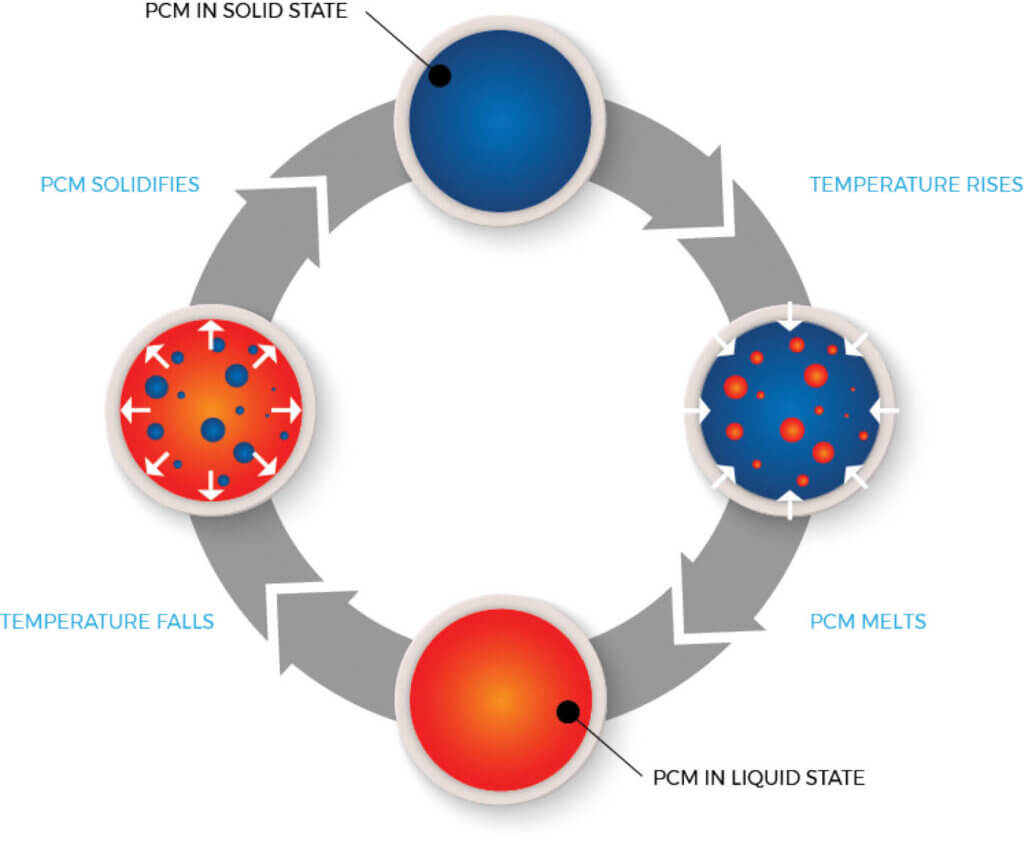
At a high level, most cooling systems combine several functions—cool-to-the-touch materials, heat absorption, heat dissipation, and moisture management. Blackburn describes Alexium’s approach as a coordinated process: “Our technology absorbs excess body heat, stores it temporarily, and releases it as your body temperature drops,” he says, emphasizing that the goal is “longer-lasting cooling, not just a quick cool feel.”
Outlast’s approach follows a similar principle of balance and responsiveness. “It absorbs excess body heat when it builds up and releases it again when needed,” Bentz explains. “The benefit is less overheating, less sweating, and a more stable sleep climate.”
Devan builds on this idea by layering multiple effects into one system. “You get an immediate fresh feeling, plus ongoing temperature control, plus an adaptive cooling effect that responds when your body needs it most,” Teixeira says. This kind of explanation allows RSAs to communicate key product attributes without overwhelming the customer.
Ultimately, the goal is not to teach the customer how the technology works in detail, but to answer a simpler question: What happens when I get too warm, and how does this product help?
Elevating moisture management
One of the most overlooked aspects of cooling—and one of the most important—is moisture management. While many conversations focus on temperature alone, humidity and perspiration play a significant role in how hot a sleeper feels.
“Cooling and moisture management are key factors,” says Walter Bridgham, senior business development manager at Lenzing. “Sales associates too often forget about where the body heat and humidity go.”
When moisture is trapped, it amplifies discomfort and contributes to overheating. When it is absorbed and allowed to evaporate, it creates a natural cooling effect. “Evaporative cooling is a highly efficient mechanism,” Bridgham explains. “The more you can pull heat and humidity away from the body, the cooler and drier the sleep environment.”
Materials such as TENCEL™ Lyocell and Modal fibers are designed to support this process. “They bring natural cooling, a cool-to-the-touch feel, and strong moisture management,” Bridgham says. By incorporating this dimension into the conversation, RSAs can provide a more complete and credible explanation of how cooling actually works over the course of a night.
And because cooling is not always visible, physical demonstrations can be one of the most effective tools on the sales floor. They allow customers to feel or see differences that might otherwise be difficult to explain.
“The most effective demos are simple and physical,” Cleyman says, pointing to techniques like airflow comparisons and moisture dispersion tests. These demonstrations make abstract benefits tangible in seconds.
Bentz agrees that simplicity is key. “If customers can feel a difference, they immediately understand it,” he says. A quick touch test or hand placement on a surface can often communicate more than a detailed explanation.
Bridgham highlights the effectiveness of visual demonstrations as well, such as using a dropper to show how quickly moisture is absorbed and spread across different fabrics. “That makes the benefit visible,” he notes.
Of course, not all shoppers are looking for the same type of cooling experience, which is why a one-size-fits-all sales approach often falls short. The most effective RSAs begin by understanding the customer’s specific needs and then tailoring the message accordingly.
“It starts with asking the right question,” Blackburn says. “Do you tend to feel hot throughout the night, or are you just looking for that cool-to-the-touch feel?”
From there, the conversation can shift in a more targeted direction. Teixeira explains that customers who overheat should be guided toward products that emphasize breathability and long-term regulation, while those seeking an immediate sensation may respond more to surface cooling features.
Cleyman points out that some customers have more complex needs, such as those experiencing temperature fluctuations. “With menopause, for example, it’s not just heat—it’s spikes and drops,” he says. “In those cases, cooling acts as a buffering system that helps stabilize those swings.”
This personalized approach not only improves the likelihood of a successful sale but also reinforces the RSA’s role as a trusted adviser rather than just a salesperson.
“The key is simplification and consistency,” Cleyman says. “Explain it as if you’re explaining it to a 7-year-old.”
Across the board, experts agree that training should focus on clear frameworks, hands-on demonstrations, and customer-oriented language. “The most effective tools are the ones that simplify,” Teixeira says, noting that short modules and visual aids tend to resonate more than deep technical dives.
Bentz highlights the value of demonstration tools (the visual aids just mentioned) as “silent sales assistants” that allow customers to experience the benefit directly. And while technical data still plays a role, it must be translated into meaningful insights. “Training should be grounded in real performance data but expressed in a way customers can understand,” Blackburn says.
When RSAs feel confident in their understanding and delivery, the entire conversation becomes more natural and more persuasive.
Turning clarity into conversion
As cooling technology continues to evolve, the way it is discussed and sold must evolve as well. Increasingly, the industry is moving away from single-feature solutions toward integrated systems that combine multiple mechanisms into a cohesive whole.
“Cooling is evolving from a single-material feature to a system-level solution,” Blackburn says. This shift reflects a broader trend toward combining heat absorption, moisture management, airflow, and adaptive responses into a unified performance story.
Teixeira notes that the focus is also shifting toward durability and long-term effectiveness. “Cooling is evolving beyond short-term sensory effects toward long-lasting comfort and balance,” he says. In addition, material collaboration—such as combining active cooling fibers with moisture-managing ones—is driving innovation forward.
For RSAs, this evolution reinforces a key takeaway: The future of cooling is not about what a product is made of, but how it performs over an entire night of sleep.
In a category crowded with claims, credibility is one of the most valuable tools an RSA can have. Simplifying the message, reframing expectations, demonstrating benefits, and tailoring the conversation to the customer makes cooling more than a buzzword; it’s a believable, compelling reason to buy.
In today’s retail environment, that credibility is what ultimately turns interest into action. As Bentz puts it, “The simpler the message, the stronger the impact.”
Cooling 101: Words to Know on the Sales Floor
Helping customers understand cooling starts with using clear, consistent language. Here’s a quick-reference glossary retail sales associates can use to explain key concepts simply—and credibly—without overwhelming the shopper.
Active cooling: Cooling created through engineered materials or additives (such as minerals or specialized yarns) that create a cool sensation or help move heat. This often includes cool-to-the-touch effects.
Adaptive cooling: Technologies that respond to the sleeper’s body conditions, such as heat or moisture, to activate cooling when it’s needed most.
Breathability: How easily air moves through a material. Better airflow helps heat escape from the sleep surface, reducing the chance of overheating.
Cool-to-the-touch: The immediate sensation a customer feels when they first lie down. This effect typically lasts only a short time and should be positioned as a first impression, not an indicator of all-night performance.
Evaporative cooling: A natural cooling effect that occurs when moisture evaporates, drawing heat away from the body. This is a key benefit of breathable, moisture-managing fabrics.
Heat absorption: The process of pulling excess body heat away from the sleeper and storing it temporarily. This is often associated with phase change materials and similar technologies.
Heat buildup: The accumulation of body heat over time, which can lead to discomfort, sweating, and sleep disruption. Preventing heat buildup is a primary goal of cooling technologies.
Heat dissipation: How effectively stored heat is released or moved away from the body and mattress surface. Strong dissipation helps prevent heat from building up during the night.
Microclimate: The immediate environment around the sleeper’s body, including temperature and humidity level. Effective cooling technologies work to stabilize this microclimate.
Moisture management: The ability of a material to pull sweat away from the body and allow it to evaporate. This plays a critical role in keeping the sleep environment cool and dry.
Natural cooling: Cooling driven by fiber properties—such as those of cotton or TENCEL™ Lyocell—that enhance breathability and moisture absorption for a cooler, drier sleep environment.
Phase change materials: Materials that absorb, store, and release heat as they shift between solid and liquid states. They help moderate temperature fluctuations but are typically limited in duration.
Temperature regulation: The ability of a mattress or textile to maintain a stable sleep climate over time by managing heat buildup. This is the core of “cooling” and what most directly affects sleep quality.